April27
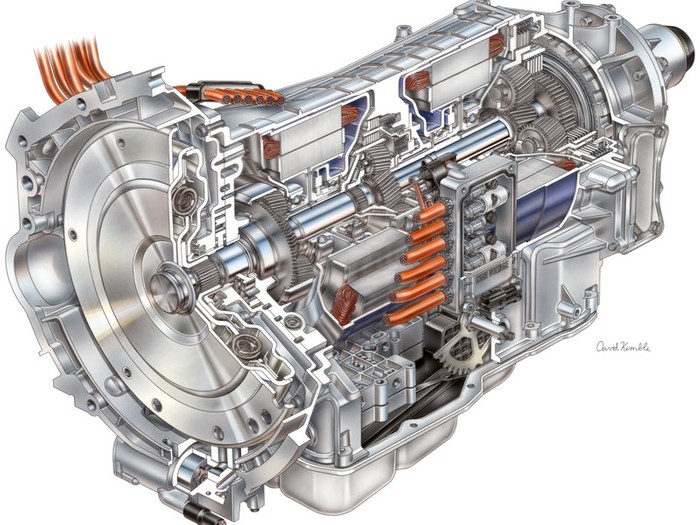
DaimlerChrysler, BMW, and GM today announced a new full hybrid system that “represents a major automotive industry milestone due to the unprecedented fully integrated combination of electric motors with a fixed-gear transmission.” The technology is said to be ready for production beginning next year. As a result of its low- and high-speed electric continuously variable transmission (ECVT) modes, the system is commonly referred to as the 2-mode hybrid. However, the sophisticated fuel-saving system also incorporates four fixed gear ratios for high efficiency and power-handling capabilities in a broad variety of vehicle applications. During the two ECVT modes and four fixed gear operations, the hybrid system can use the electric motors for boosting and regenerative braking.
In summary, the four fixed gears overlay two ECVT modes for a total of six operating functions:
- Input-split ECVT mode, or continuously variable Mode 1, operates from vehicle launch through the second fixed gear ratio.
- Compound-split ECVT mode, or continuously variable Mode 2, operates after the second fixed gear ratio.
- First fixed-gear ratio with both electric motors available to boost the internal combustion engine or capture and store energy from regenerative braking, deceleration and coasting.
- Second fixed-gear ratio with one electric motor available for boost/braking.
- Third fixed-gear ratio with two electric motors available for boost/braking.
- Fourth fixed-gear ratio with one electric motor available for boost/braking.
The system has an overall mechanical content and size similar to a conventional automatic transmission, yet this full hybrid transmission can operate in infinitely variable gear ratios or one of the four fixed-gear ratios.
A sophisticated electronic control module constantly optimizes the entire hybrid powertrain system to select the most efficient operation point for the power level demanded by the driver.
Key Advantages
When compared to conventional hybrid systems, this avant-garde hybrid technology, relying on both the ECVT modes and the four fixed gear ratios, provides advantages in combined (city and highway) fuel economy, dynamics and towing capability.
Traditional hybrid systems typically have only one torque-splitting arrangement and no fixed mechanical ratios. These systems are often called “one-mode� hybrids. Due to their less capable mechanical content, one-mode hybrids need to transmit a significant amount of power through an electrical path that is 20 percent less efficient than a mechanical path. This requires usually substantial compromise in vehicle capability or reliance on larger electrical motors, which can create cost, weight and packaging issues.
General Motors, DaimlerChrysler and the BMW Group have conceived a full hybrid system featuring four fixed mechanical ratios, within the two ECVT modes, to reduce power transmission through the less efficient electrical path. Consequently, the electric motors are more compact and less dependent on engine size.
This combination of two ECVT modes and four fixed gear ratios eliminates the drawbacks of one-mode hybrid systems to allow for efficient operation throughout a vehicle’s operating range, at low and high speeds. It also allows for application across a broader variety of vehicles. It is particularly beneficial in demanding applications that require larger engines, such as towing, hill climbing or carrying heavy loads.
Existing internal combustion engines can be used with relatively minimal alteration because the full hybrid system imposes no significant limitation on the size or type of engine. It enables the three global automakers to package internal combustion engines with the full hybrid transmissions more cost-effectively and offer the fuel-saving technology across a wider range of vehicles.
Initial applications are suitable for front-engine, rear- and four-wheel-drive vehicle architectures, but the full hybrid system has the flexibility to be used in front-engine, front-wheel-drive architectures in the future as well.


wow all three announced on the same day!
well yeah, they co-developed it
[...] Site - http://www.leftlanenews.com [...]
Do people think before they post here? If you read the article, it’s pretty obvious that it is the same system, developed jointly by the three.
But because we don’t think, it’s just such a coincidence that all three announced their hybrid systems on the same day!
you know, I never thought I would see those three companies working together. I always thought BMW would scoff at hybrids forever and continue with their hydrogen burning engines.
[...] The three companies teamed up over the last few years and built this: a two-mode hybrid with an ECVT transmission. It incorporates four fixed gears for high efficiency and power-handling capabilities. During the two ECVT modes and four fixed gears, the system can use the electric motors for boosting and regenerative braking.read more | digg story [...]
Collaboration is necessary because of the tremendous investment in time and R&D. It is very difficult for one company to risk that investment and suffer the possible loss if the product proves uneconomic. One big loser these days can sink even a large automotive company. The economies of scale is staggering. It is a double edged sword that cuts both ways. The investment can be shared as well as the benefits and potential losses. However, I worry that brand engineering distinctness/uniqueness will be lost over time, and the power of that marketing aspect, and brand pride, will be diluted. I guess as long as the general customer/buyer base is not enlightened, the negative aspects can be reduced significantly. We have all watched as various carmakers have reduced product lines that share common products with mostly cosmetic differences, ie; Dodge/Plymouth, Buick/Oldsmobile/Pontiac, etc. I hope we don’t see the auto industry condensing to just a few choices. I rather enjoy recognizing different brands and the aesthetic/engineering uniquenesses. I would rather avoid the negatives I have witnessed with the globalization and absorption of unique brands into a conblomerate such as Chrysler/Daimler, Ford/Jaguar/Aston-Martin/Volvo/Mazda, GM/SAAB/Fiat(almost)/Isuzu/Opel, etc., etc. There many examples across the pond also but I just wanted to show some examples. however,I also recognize the advantages of these mergers as stated above.
[...] Click here to view the full article [...]
This looks like an excellent design and much further along than Hybrid Synergy Drive. BMW said that they’ll use super capacitors (ultra caps) to store the energy recovered from dynamic braking which is a huge win for overall efficiency. They have scored with this one: no torque converter, much better dynamic range, grabs energy from braking, packaged appropriately requiring no major changes to the driveline and, if they use ultra caps, less dependancy on batteries. The engine doesn’t start and stop all the time either. Kudos!
a ner ner