

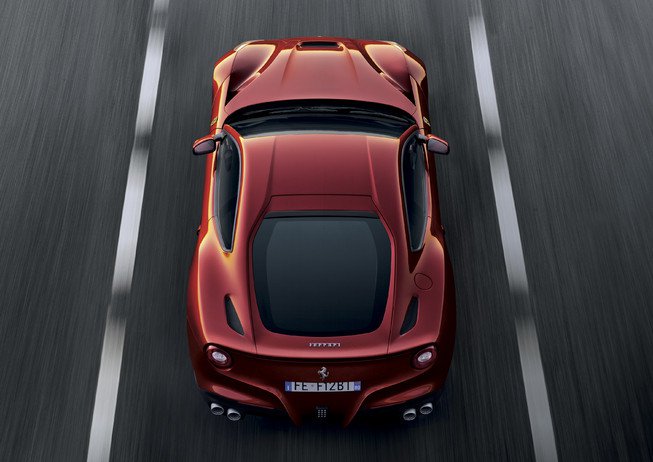
The Ferrari F12berlinetta is a mid-front-engined coupe that is more expensive and more powerful than any road-going member of the Prancing Horse’s lineup save for the mighty, limited-edition LaFerrari.
Bucking the industry’s downsizing trend, the F12berlinetta uses a naturally-aspirated 6.3-liter V12 engine that churns out 730 horsepower and 509 lb-ft. of torque. Linked to a seven-speed dual-clutch gearbox, the mill sends the F12 from zero to 60 mph in 3.1 seconds, from zero to 124 mph in 8.5 seconds and on to a top speed of 211 mph.
The F12berlinetta returns 12 mpg in the city and 16 mpg on the highway when driven conservatively. The aforementioned statistics are evidently far below the industry average but they make the F12 one of the most fuel-efficient cars in its segment.
Huge carbon ceramic brakes on all four corners keep the extra power in check, while vanes that open automatically at high speeds help route cool air to the rotors and the calipers. The electronic driving aids include a high-performance ABS system, Ferrari’s F1-Trac traction control, ESP Premium and an electronic differential.
The F12’s chassis and body are crafted out of 12 different kinds of alloy in order to reduce weight and increase structural rigidity. Thanks to careful packaging, 54-percent of the coupe’s 3,362-pound weight lies on the rear axle.
Aerodynamics First
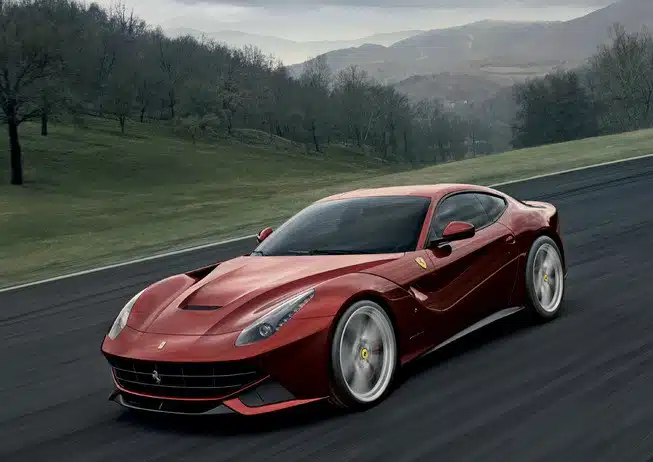
Penned jointly by Ferrari’s in-house styling department and Pininfarina, the F12berlinetta’s aggressive design is noticeably inspired by the four-seater FF. Its front end is characterized by a long, sculpted hood, sharp headlamps and Ferrari’s signature egg-crate grille. Vents on the hood reduce drag by routing air away from the top part of the car.
Heavily-sculpted flanks and a functional air diffuser integrated into the rear bumper further enable the F12 to cheat the wind, while round tail lamps pushed to the extremities of the rear end emphasize the car’s width.
Driver-Focused Cockpit
The F12berlinetta offers a premium, high-tech cockpit with numerous aircraft-inspired touches. The two passengers are treated to round air vents made with carbon fiber and aluminum, exquisite Frau leather on the seats, the center console and the dashboard as well carbon fiber trim on the dash.
The driver sits in front of a three-spoke, flat-bottomed steering wheel that houses every major command including switches for the turn signals, the headlights and the windshield wipers, a knob used to select a driving mode and a button that turns the engine on and off. The climate controls are conveniently located on the dashboard.
The instrument cluster consists of a large tachometer mounted front and center. It is flanked by a speedometer, a fuel gauge and gauges for the oil and water temperature.
Interestingly, a small, discreet screen mounted above the glovebox gives the passenger basic information such as the engine’s rpms and the speed the car is traveling at.
Tailor Made
Buyers with extra cash in their pocket can customize their F12berlinetta through Ferrari’s Tailor Made program. Every aspect of the car down to the minutest detail can be modified by the buyer with the help of a Ferrari-assigned personal designer whose job is to guide future owners through every step of the customization process.
Key Competitors
Shoppers in the market for an ultra-fast and ultra-expensive two-seater should also consider the Aston Martin Vanquish and Lamborghini Aventador.
Base Price : $319,995